


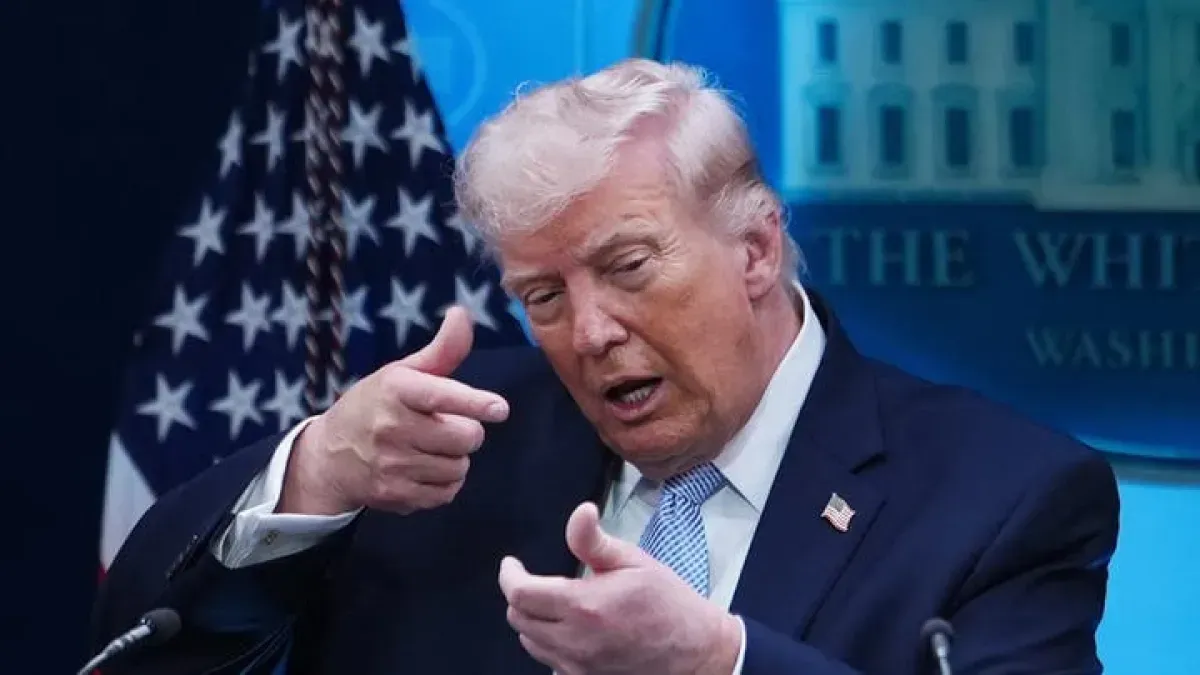
The Middle East is facing its most dangerous juncture in modern history as fragile political understandings have collapsed, and the language of conflict has returned to dominate the scene between the United States and Iran. Merely weeks after an internationally brokered memorandum of understanding was signed in Switzerland to end a bloody conflict that erupted in early 2026, frontlines have reignited with unprecedented ferocity, threatening to plunge the region and the world into a full-scale war of attrition with an unpredictable outcome. This rapid deterioration confirms the foresight of strategic analysts who described the de-escalation as a mere respite. Both sides refuse to make fundamental concessions that touch upon their red lines, whether concerning the nuclear program, regional influence, or the security of vital waterways that serve as the lifeline of the global economy. The spark of the latest escalation ignited in the Strait of Hormuz, the world's most critical energy transit chokepoint. In a move that signaled Tehran's determination to assert full maritime sovereignty, a commercial cargo ship transiting the strait was directly struck by a projectile that hit its starboard side, causing severe damage to its bridge. This attack followed shortly after warnings issued by the Iranian Revolutionary Guard Corps (IRGC), which asserted that commercial vessels would only be granted safe passage through the strait via maritime routes designated and announced by Iranian authorities. Tehran stated that imposing fees and controlling transit movement is an inalienable sovereign right, directly challenging repeated declarations by the administration of U.S. President Donald Trump, which emphasized that the recent agreement guarantees free and unconditional maritime navigation for all nations. The incident caused significant alarm in global economic and military circles. The International Maritime Organization (IMO) swiftly suspended all plans to evacuate stranded vessels in the region due to emergent security risks, foreshadowing a potential return of oil prices to record highs after they had begun to stabilize gradually following the ceasefire. The U.S. military response was swift. The U.S. Central Command (CENTCOM) announced the launch of a broad and focused aerial operation against key military targets deep within Iran. A CENTCOM official statement indicated that U.S. forces delivered powerful strikes directly targeting ballistic missile storage sites, drone depots, and IRGC coastal radar networks along the country's southern coast. Washington characterized Iran's recent military actions as unjustified aggression and a blatant violation of the ceasefire and the memorandum of understanding signed between the two parties. The U.S. military affirmed in its statements that it would not stand idly by in the face of any attempt to undermine international freedom of navigation, asserting that its agreement to the de-escalation did not signify a relinquishment of military readiness or a relaxation in protecting global trade, and stressed that its forces would remain vigilant to enforce full adherence to the agreements. In response, Tehran did not remain silent. The Iranian Foreign Ministry issued a strongly worded statement announcing that Iranian armed forces had attacked targets and facilities linked to U.S. forces in the region, in retaliation for what it described as blatant aggression. Tehran considered the U.S. airstrikes on its southern coast to be a flagrant violation of the United Nations Charter and a gross breach of the war-ending memorandum. The Iranian statement coincided with field reports indicating that drone and missile attacks had targeted military facilities and bases in several Gulf and neighboring countries hosting U.S. forces. Military commanders in Tehran vowed to escalate retaliatory measures and target U.S. interests unprecedentedly if the raids were repeated, considering that a policy of escalation for escalation is the only strategy capable of curbing the U.S. administration and compelling it to lift the comprehensive blockade on Iranian ports. The current situation cannot be understood in isolation from the Lebanese arena, which has become one of the most complex obstacles to any de-escalation between Washington and Tehran. According to diplomatic sources, the U.S.-Iran memorandum of understanding stipulated the necessity of reaching a comprehensive ceasefire that includes the Lebanese front. However, the framework agreement brokered by Washington between Tel Aviv and official Beirut encountered staunch rejection from Hezbollah. The Secretary-General of Hezbollah, Sheikh Naim Qassem, declared in an official statement that the framework agreement constitutes a grave misstep and an unacceptable concession of national sovereignty, describing it as an agreement of surrender and humiliation because it mandates the disarmament of the party throughout Lebanese territory in exchange for an Israeli withdrawal. This on-the-ground rejection was immediately translated by the party through the resumption of rocket shelling towards northern Israel, in response to the intense airstrikes carried out by the Israeli Air Force on the southern suburbs of Beirut and areas in Nabatieh. This organic linkage between the Tehran and Beirut fronts has proven the failure of U.S. attempts to separate the tracks, as Iran considers any harm to Hezbollah or an attempt to impose its disarmament to be a direct breach of major understandings, which previously prompted it to launch missile strikes against Israel in solidarity with its allies in Lebanon. On the other side of the ocean, U.S. President Donald Trump faces immense political and economic pressure in Washington. Despite his stated inclination to forge deals that end costly wars both economically and humanly, Iran's recent violation of maritime navigation has placed him in a precarious position before Republican Party stalwarts and Congress. Heated debates and legislative battles are underway in congressional corridors regarding funding for the costs of this regional war, estimated at billions of dollars, which was not included in previous defense budgets. The Trump administration has begun requesting urgent additional funding from lawmakers, amidst sharp divisions within the opposition Democratic Party, some of whose representatives seek to impose restrictions on military aid to Israel to limit the expansion of the conflict. In an attempt to control the narrative, Trump issued stern public warnings to the Israeli side, urging restraint and avoiding being drawn into the desire of some leaders in Tel Aviv to expand the ground war in Lebanon, a step that Vice President J.D. Vance considered a real danger that could derail all diplomatic efforts and force Washington into a long-term war of attrition it does not desire. Many military analysts believe that the current conflict between the United States and Iran is no longer centered on the ability to achieve overwhelming battlefield superiority, but rather on endurance and a prolonged war of nerves. The United States and its ally Israel possess immense technological and aerial superiority, enabling them to deliver precise and lethal strikes against Iran's military and nuclear infrastructure. However, over decades, Iran has developed a doctrine of asymmetric warfare based on networks of ballistic missiles, suicide drones, and local allies spread across a complex geography extending from Iraq to Yemen and Lebanon. Iran's strategy relies on increasing the cost of war economically and politically for Washington; a few days of threats to the Strait of Hormuz are sufficient to shake global financial markets and instill anxiety in the arteries of the Western economy. Attacks on U.S. bases in the region are also intended to send clear messages to host countries that harboring U.S. forces carries grave security risks, which may push those governments to pressure Washington to cease escalation. The Middle East stands today before two scenarios, with no third option. The first is a slide towards a comprehensive explosion, where reciprocal strikes and retaliatory responses lead to the complete collapse of the Swiss memorandum of understanding, and the expansion of military operations to include the destruction of vital oil and nuclear facilities. This would signify an open regional war that would cast a dark shadow over international security and peace, causing uncontainable refugee and economic crises. The second scenario is a forced return to the negotiating table under the deterrent of catastrophic mutual destruction. The Trump administration, burdened by domestic economic and political costs, and the new Iranian leadership, facing difficult internal economic challenges, may find that continuing the war threatens their existence and sovereign stability. This could ultimately push them to make painful mutual concessions, ensuring the formulation of a new, more durable, and detailed agreement that transcends the loopholes of previous accords and puts an end to the arms race and influence in the region. Between these two possibilities, the peoples of the region remain the primary victims, paying the price for this major geopolitical confrontation. |