


Yemeni Government's Conflicting Statements Raise Doubts on Strategy
|
2 hours ago
A-
A+
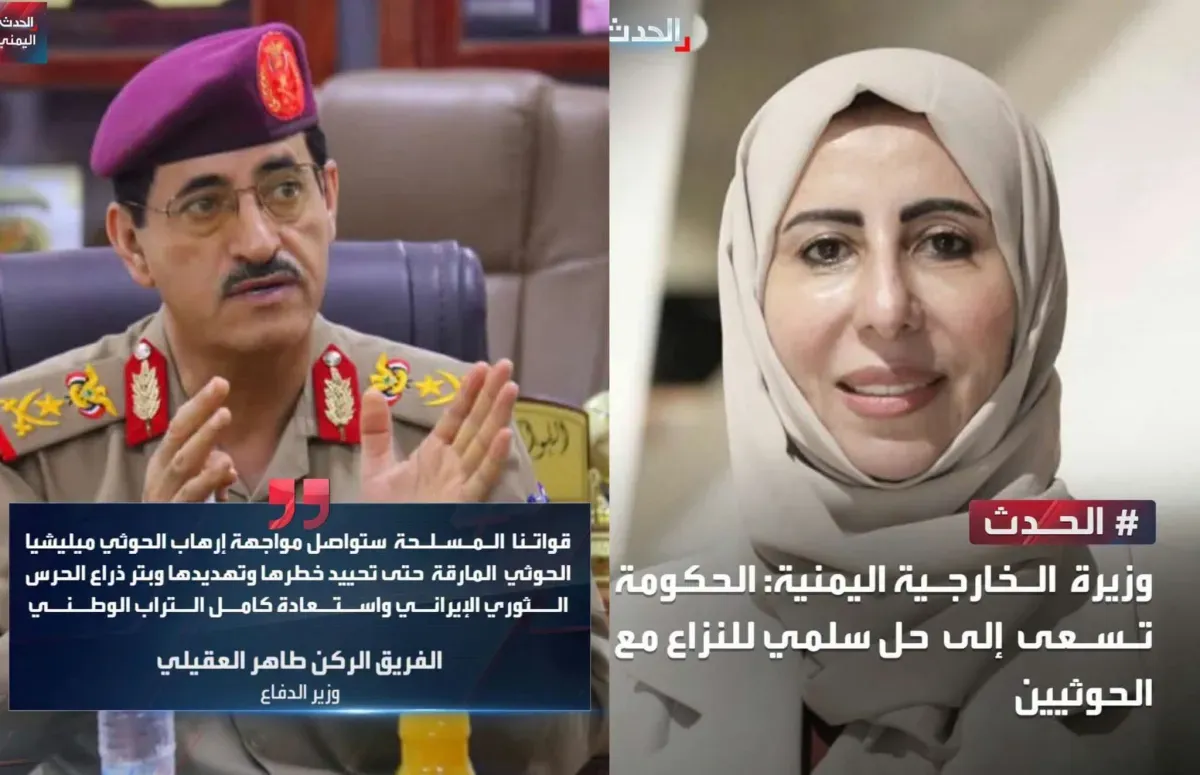
Conflicting statements from the Yemeni government's ministers of defense and foreign affairs regarding the approach to Houthi militants have ignited questions about the existence of a unified vision and a clear strategy governing the government's stance on the coup. This comes amid a persistent divergence between discussions of force and the pursuit of a political settlement. While Defense Minister Lieutenant General Tahir Al-Aqili asserted that the armed forces would continue confronting what he described as "Houthi terrorism" until its threat and dangers are dissipated, even if it necessitates the use of force, the Foreign Minister spoke of the government's pursuit of a comprehensive political solution to the conflict with the Houthi group. Between these two positions, a fundamental question arises about the nature of the strategy the government employs in dealing with the Houthi coup. It is unclear whether military and political options represent complementary paths within a single national vision or reflect discrepancies in state institutions' assessments and a lack of a central decision-making hub. The issue is not inherently in combining force and political action, as conflict management typically involves parallel employment of military and diplomatic tracks. Force serves as a tool to protect the political path and bolster the state's position, while negotiations remain a means to end the conflict and restore state institutions. However, the absence of a declared framework clarifying the relationship between these two tracks creates ambiguity. This is particularly true given the lack of clarity regarding the objectives achievable through military action or the conditions and guarantees underpinning the government's approach to any potential political settlement. Observers suggest that the continued issuance of divergent positions from government institutions on the same issue may weaken its ability to present a cohesive political discourse and provide other parties with opportunities to exploit these differences. The current phase demands unified messages and stances on one of Yemen's most complex challenges. This situation arises after years of war and coup, during which the government continues to face the challenge of presenting an integrated national project that clearly defines the nature of the state it seeks to restore, the mechanisms for ending the coup, and the roles of military, political, and economic institutions in achieving this goal. Analysts emphasize that the slogan "restoring the state" requires practical translation beyond political rhetoric, through a national strategy that defines priorities and objectives, unifies the government's institutional work, and establishes a clear framework for the relationship between military action and political and diplomatic engagement. Furthermore, discussions of a political solution need to clarify the foundations upon which they are based, ensuring that negotiations do not become a path that grants legitimacy to the coup or entrenches the reality imposed by the militia through force. Conversely, discussions of military options require the definition of their objectives, capabilities, and timing, distinct from general statements. Amidst the ongoing crisis, there is an urgent need to build a comprehensive national vision that goes beyond military or political conflict management. It must encompass addressing economic imbalances, strengthening state institutions, unifying decision-making, and developing a media discourse capable of presenting clear objectives to the public. Observers warn that continuing to operate based on reactions and multiple government discourses could weaken the national position and confuse allies and the international community, especially when messages from different institutions are not linked to a declared plan or a unified political objective. Between the option of force and the path of negotiation, the core issue remains the government's ability to transform the multiplicity of tools into an integrated strategy, rather than appearing as competing options or separate stances. Force, without a clear national project, could become a tool without a defined political purpose. The political path, without guarantees and protective force, could become an entry point for concessions that do not serve the restoration of the state. With the continuation of the Houthi coup, Yemen does not appear to need more divergent statements, but rather a government with a unified vision that knows when to use force, when to engage in negotiations, and what objective it seeks to achieve through both paths. The restoration of the state cannot be built on multiple discourses or conflicting messages, but on a comprehensive national project, a clear strategy, and unified political decision-making that makes military and political tools integrated means to achieve a single goal, not parallel paths moving in different directions. |