


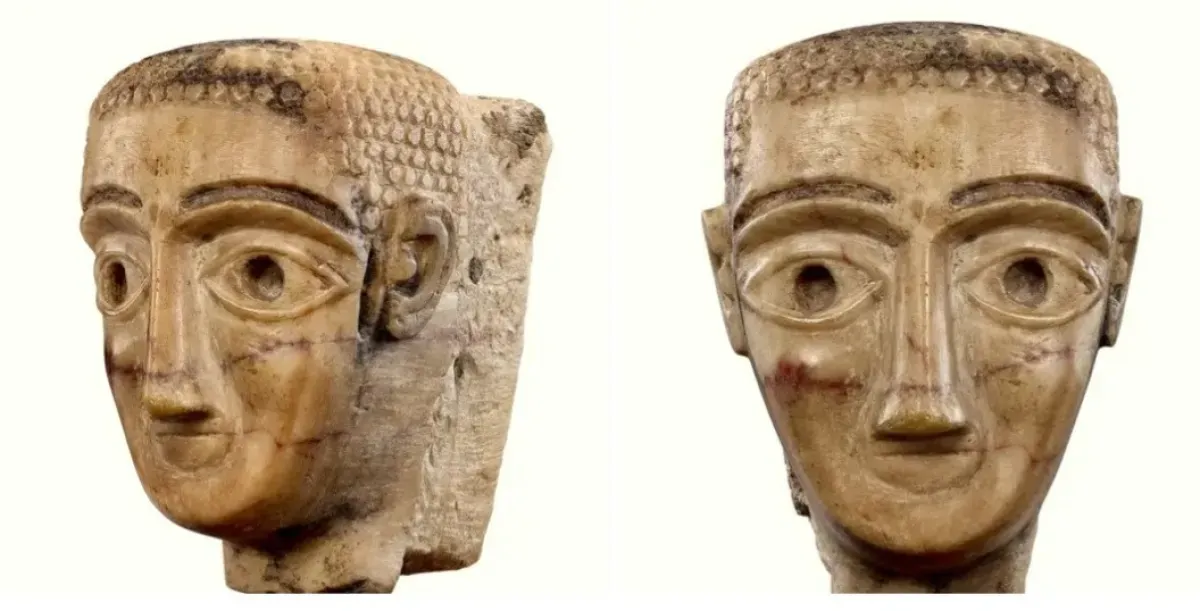
A specialized researcher in Yemeni antiquities has revealed that a rare, ancient marble head, believed to originate from ancient Yemen, is currently being offered for sale through Christie's auction house's "Private Sales" division. The researcher, Mohsen, stated on Facebook that the artifact is a portrait head dating approximately between the 3rd century BCE and the 1st century CE, standing about 13 centimeters tall. According to the listing, the piece was part of the collection of Antonin and Christian Bessis. Historical records suggest its origin might be from Bayhan, and it was reportedly acquired in Yemen during the 1960s, with export registration in Aden in 1967. Mohsen noted that Christie's use of the phrase "said to be from Bayhan" indicates a degree of uncertainty regarding the artifact's precise provenance. He also pointed out that the same piece was previously offered at Sotheby's in London on December 7, 2021, as part of a collection of 24 rare Yemeni artifacts that sold for over $2.5 million. He elaborated that the current offering through "Private Sales" differs from public auctions, as these transactions occur outside the auction room without open bidding. This method can offer greater privacy, and the identities of the buyer and seller, as well as the transaction value, are not necessarily disclosed. Major auction houses like Christie's, Sotheby's, and Bonhams provide such private sales services for clients wishing to buy or sell art and collectibles away from the open market, while still being obligated to verify parties involved and adhere to legal and regulatory frameworks. In a related context, the researcher expressed concern over the increasing circulation of Yemeni ancient coins in international auctions, observing a notable rise in the offering of Yemeni gold coins and jewelry in global markets. He highlighted that tracing the origin of these coins presents a significant challenge, as they were originally created for trade and have historically moved between different regions and countries. He emphasized that simply identifying a coin as belonging to the Sabaean, Himyarite, Qatabanian, or Ma'in civilizations is insufficient to prove its recent and illicit removal from Yemen. Mohsen urged official bodies to address the issue of ancient coinage with a clear protocol, especially in light of the looting, illicit excavation, smuggling, and destruction that Yemeni archaeological sites and cities have endured in recent years, alongside the appearance of Yemeni artifacts in international auctions and online marketplaces. |