


US Court Upholds Seizure of Iranian Oil Linked to Turkish Network
|
18 hours ago
A-
A+
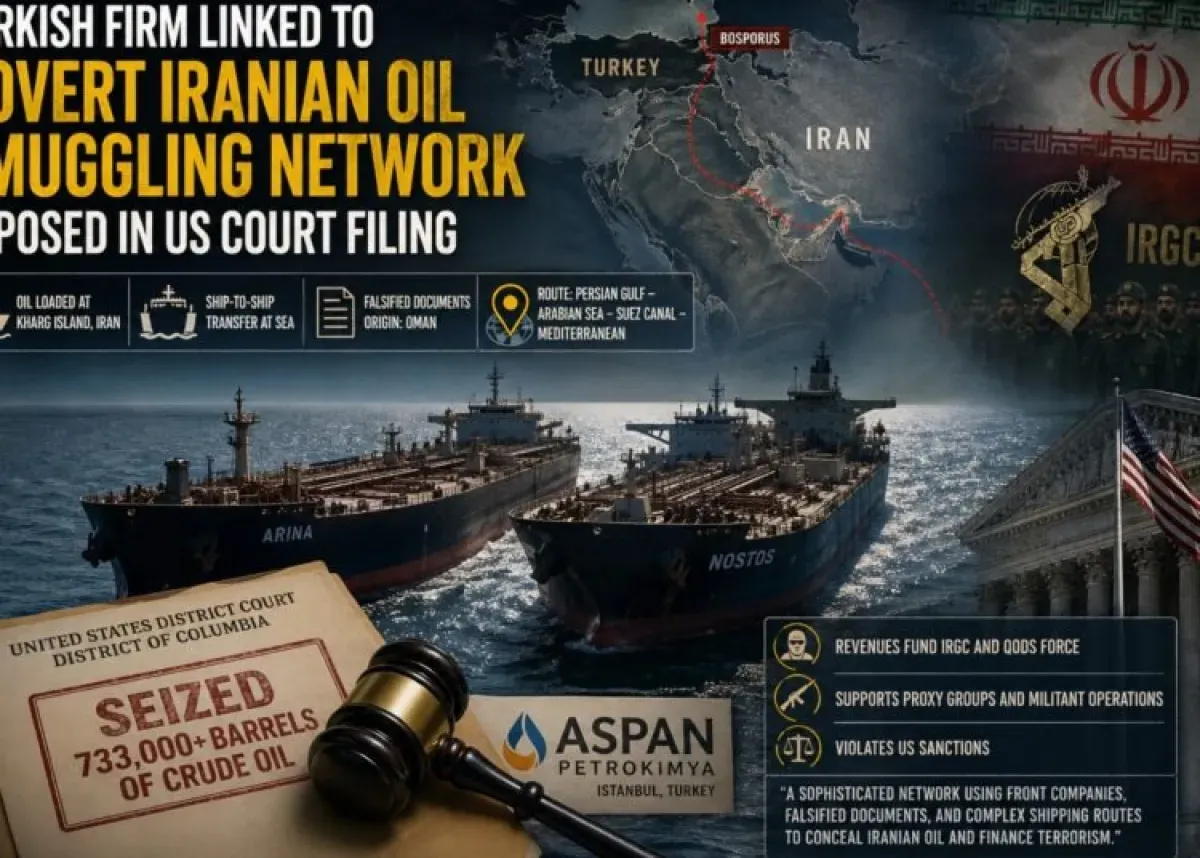
A sophisticated sanctions evasion network tied to Iran's Islamic Revolutionary Guard Corps (IRGC) has been exposed by a U.S. federal court case, which recently saw an appellate ruling uphold the seizure of an oil shipment. The network involved a Turkish company operated by Iranian nationals, aiming to obscure the origin of Iranian oil and channel proceeds to entities accused of financing terrorism. The case, filed in the U.S. District Court for the District of Columbia, centers on the confiscation of oil from two tankers as part of a broader investigation into illicit Iranian oil trade. U.S. prosecutors allege that a purported purchase by the Turkish firm, Aspan Petrochemicals, controlled by an Iranian national, was not a legitimate commercial transaction but a scheme to enable Iranian state entities, including the IRGC, to exploit oil shipments in violation of U.S. sanctions. Details revealed in the case illustrate a meticulous operation designed to conceal the oil's Iranian origin. The crude oil was loaded at Iran's Kharg Island and subsequently transferred between vessels at sea, with the deliberate disabling of Automatic Identification System (AIS) transponders to evade tracking. Shipping documents were falsified to falsely identify the shipment's origin as Oman. Satellite imagery included in the lawsuit depicts ships positioned adjacent to each other in the Persian Gulf, corroborating covert ship-to-ship transfers. The cargo, exceeding 733,000 barrels, remained at sea for months and traversed multiple strategic waterways, including the Turkish-controlled Bosphorus Strait, indicating an effort to integrate the shipment into global trade while masking its source. U.S. authorities characterize the case as part of a wider effort to dismantle financial networks supporting armed activities, as revenues from Iranian oil sales are a primary funding source for the IRGC and its Quds Force. Prosecutors describe the IRGC as a dominant economic force within Iran, deeply entrenched in energy, shipping, and finance sectors, utilizing a complex web of shell companies and intermediaries to obscure its role and generate substantial revenue. The involvement of a Turkish company exacerbates Western concerns about Turkey's increasing exposure to sanctions evasion networks. Previous investigations have pointed to Turkish companies being used as conduits for restricted trade. The Halkbank case, which surfaced in 2013 and evolved into a major U.S. criminal case in 2016, highlighted how Turkey's state-owned Halkbank facilitated billions of dollars in illicit money laundering for Iran. Numerous Turkish companies have faced U.S. criminal scrutiny, and many entities and individuals based in Turkey have been placed under sanctions. Aspan Petrochemicals was registered in Istanbul in 2020 with a broad commercial mandate. Records indicate changes in ownership, with the company eventually transferred to an Iranian national residing in the UAE, who subsequently sought to amend her identification records to register as an Emirati citizen, a move suggesting an attempt to conceal her background. Nevertheless, U.S. prosecutors argue that the evidence leaves no doubt regarding the company's role. Aspan challenged the seizure decision in U.S. courts, but the U.S. Court of Appeals for the District of Columbia Circuit upheld the government's position, affirming the oil's confiscation. The court ruled that ownership must be determined at the time of the illegal act and concluded that evidence demonstrated the National Iranian Oil Company's control over the oil. It also noted that Iranian oil transactions have a direct impact on global markets and that close coordination between the NIOC and the IRGC supports the conclusion that these deals were intended to support activities targeting governments, including the United States. For Turkey, these findings highlight structural vulnerabilities that expose Turkish companies to secondary U.S. sanctions, undermine confidence in the country's regulatory and financial oversight mechanisms, and reinforce the perception that Turkey is increasingly utilized as a channel for illicit trade and sanctions evasion networks. |