


Houthi Exploitation: Marginalized Black Yemenis Face Forced Military Mobilization
|
5 hours ago
A-
A+
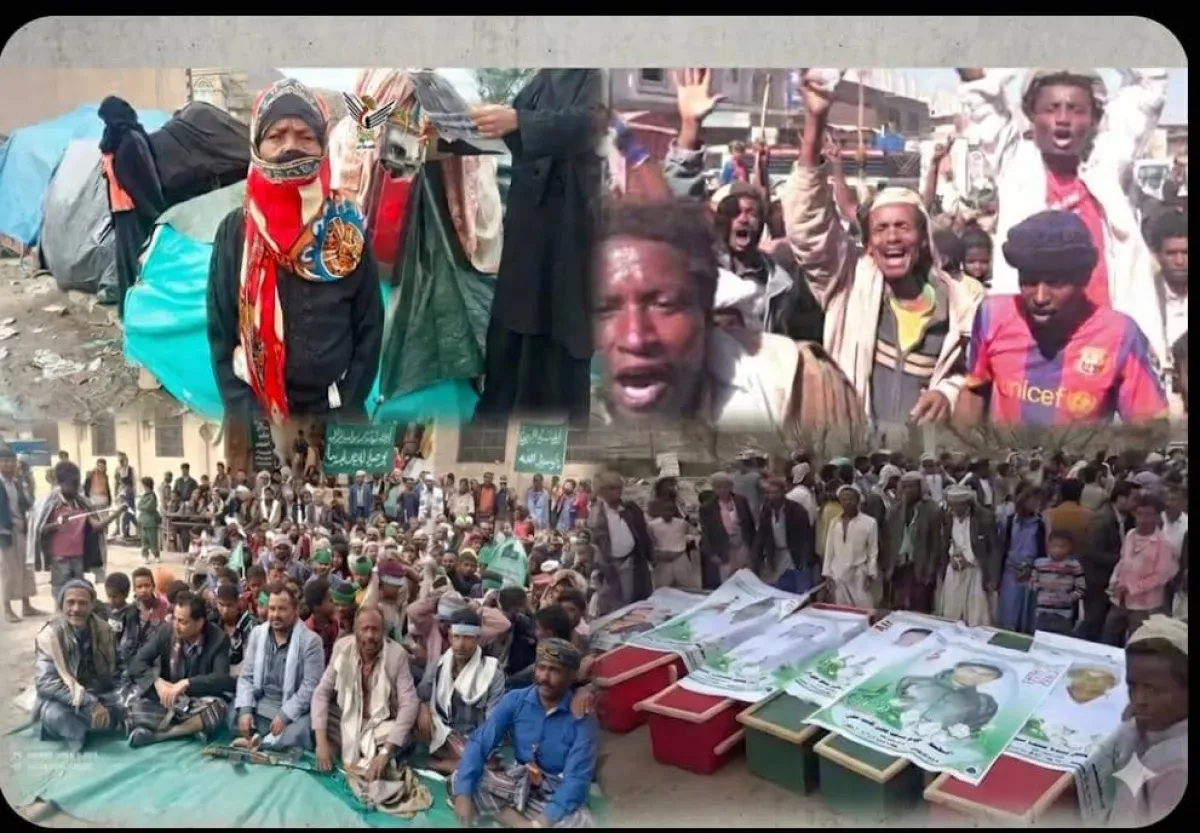
Since the Houthi militia's coup in September 2014, the segment of the population identified as individuals of Black descent within Houthi-controlled areas has endured escalating suffering characterized by intensified exploitation, extending beyond social spheres into military mobilization linked to the ongoing conflict. As the militia solidified its grip over state institutions and the public domain, this demographic became a direct target for organized mobilization policies rooted in religious rhetoric and symbolic slogans. In practice, this translates into assignment to arduous and perilous roles devoid of protection or guarantees. In the years following the takeover, the militia's discourse began employing the term "Descendants of Bilal" as a designation purportedly carrying religious reverence. However, the reality on the ground indicates this nomenclature has not resulted in any tangible improvement in living conditions or rights. Instead, it has coincided with an increased frequency of summons for participation in activities with mobilization or direct military field components, many explicitly tied to the war effort. In several Houthi-controlled governorates, individuals from this group report persistent pressure to participate in events framed as religious or national duty. Ali, a young man from a district in Taiz governorate, stated that invitations are presented not as options, but as direct directives from local supervisors affiliated with the militia. He noted that they are called for mobilization activities or demanding collective tasks, like setting up event venues or transporting equipment, under the guise of honor as "Descendants of Bilal," yet they perform the most taxing labor without commensurate reward. This pattern of mobilization borders on coercion, as refusal is interpreted as dissent or dereliction of religious duty, constituting disobedience to the directives of militia leader Abdul-Malik al-Houthi. Over time, the religious discourse transforms into a tool for psychological pressure, justifying the assignment of overwhelming tasks without provision of health protection or legal guarantees. With the escalation of warfare across various fronts, reports and testimonies have emerged detailing the deployment of individuals from this marginalized group near active front lines or in critical support roles for military operations, marketed under the banner of defense or jihad amid intense propaganda. Umm Youssef, a mother from Ibb governorate, recounted how her son was directed to a "front support mission" toward Saada governorate without prior military training or disclosure of risks, promised a salary and employment for his father in return. He returned weeks later with a leg injury and severe psychological distress; his promised salary ceased after three months, leaving him disabled and without sustained care for four years. These accounts suggest their involvement in combat theaters occurs outside formal recruitment frameworks, relying instead on local mobilization networks lacking standards for protection or post-service care. Activists confirm that the absence of a legal framework renders them the weakest link, exposed to risks without official recognition as part of a regular force guaranteeing rights, noting that many fatalities in the war fronts are children from these marginalized groups. Exploitation is not confined to the military dimension; it extends economically, where many are restricted to war-related or mobilization activities, lacking prospects for stable civilian employment. Social researchers observe that the militia's policies on resource and job distribution have increased the dependence of weaker factions on these networks, making refusal of field or mobilization assignments a costly social and economic choice. Linking employment opportunities or aid to participation in Houthi activities creates a closed cycle of dependency, trapping them in continuous depletion while their livelihoods remain subject to the discretion of local supervisors or coup-affiliated power structures. This sustained pressure, whether through religious mobilization or proximity to conflict, inflicts deep psychological trauma. Sarah, a young woman from Ibb, expressed feeling that her identity is exploited to mandate roles her family did not choose, stating, "We are told we are honored, but in reality, we are always called upon when the work is exhausting or dangerous. I sometimes feel we are merely tools." This continuous sense of exploitation erodes self-perception and future prospects, fostering societal isolation. Specialists warn that the accumulation of these pressures risks long-term psychological issues, exacerbated by the absence of support programs. Analysts assert that the contradiction between the discourse of "honor" under the "Descendants of Bilal" label and the harsh operational reality epitomizes the exploitation. While religious language lends moral sanction to participation, the actual conditions offer no guarantees of dignity or justice. Experts in political sociology note that weaponizing identity for mobilization is a common conflict strategy, dangerously enacted here at the expense of vulnerable populations lacking means of objection. From a human rights perspective, compelling individuals into arduous or dangerous work under social or religious duress, without clear legal frameworks or health protection, constitutes violations of fundamental rights, including freedom of labor, physical safety, and protection from discrimination. Human rights reports documenting these abuses emphasize that exploiting a specific demographic in wartime, absent accountability, deepens social fissures and threatens national cohesion, potentially cementing a model of exploitation difficult to dismantle post-conflict. Focusing on the plight of Black Yemenis since the Houthi coup is not intended to incite division, but to illuminate a reality endured by thousands in silence. With every summons for mobilization or field duty, the cycle of exploitation is renewed under political and religious banners. The critical question remains: How long will this segment be utilized as a tool in the war equation without being afforded their full rights to protection, dignity, and free choice? The answer necessitates intensive media and human rights efforts to place their suffering at the forefront of public discourse and initiate serious accountability for those investing in the fragility of others to achieve their objectives. |