


Report: Red Sea Corridor Slips Back Into Crisis as Houthi Threats Resurface
|
1 day ago
A-
A+
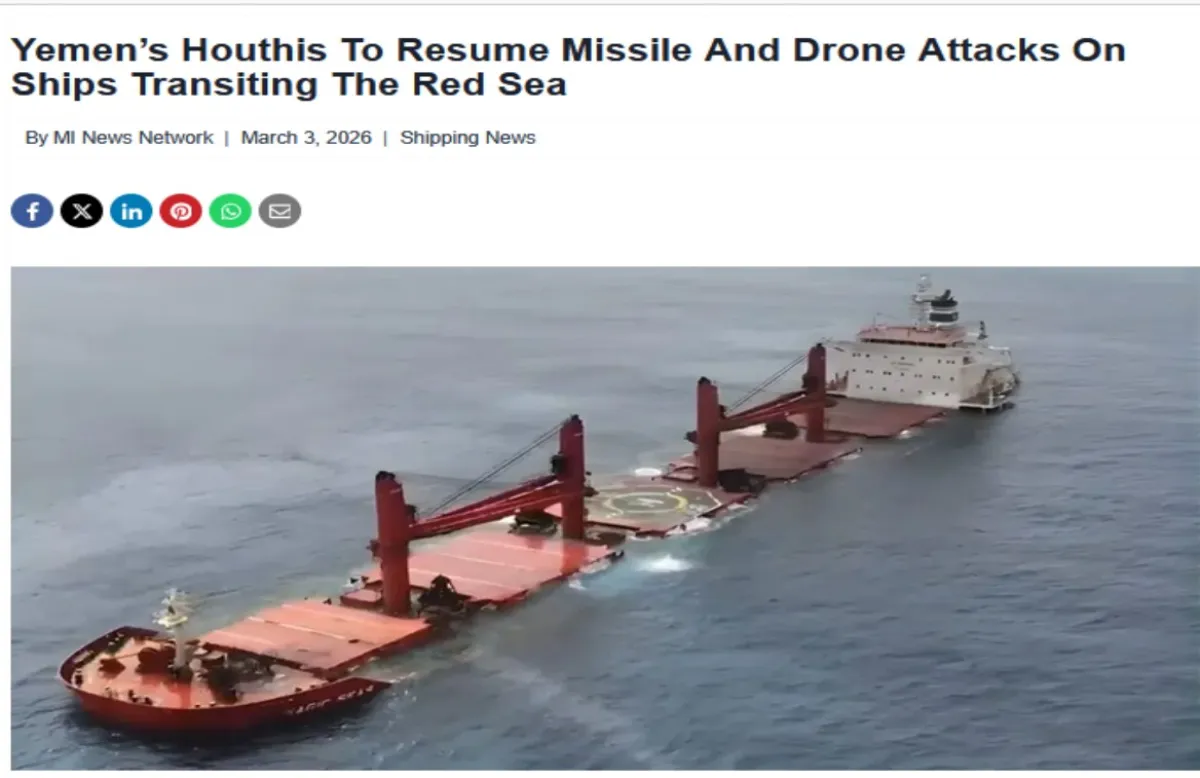
The brief reprieve in Red Sea shipping attacks ended this weekend as Yemen’s Houthi rebels signaled an imminent return to targeting commercial vessels, casting a shadow over what had been a fragile recovery in one of the world’s most critical maritime corridors, wrote Mike Schuler. Schuler, the Managing Editor of gCaptain, added “Two Houthi officials told international media that the group has decided to restart missile and drone operations against maritime traffic in response to US-Israeli military strikes on Iran”. The timing represents a sharp reversal. The Houthis had effectively paused large-scale maritime attacks in mid-November 2025 following a regional de-escalation linked to a Gaza ceasefire. From approximately November 11, 2025 until late February 2026, there were no sustained, confirmed missile or drone attacks against merchant vessels attributable to the rebels. This weekend’s statements therefore mark the end of roughly three and a half months of relative calm. The Baltic and International Maritime Council (BIMCO), the world’s largest international shipping association, warned that vessels with business links to US or Israeli interests are likely to face elevated risk if Houthi attacks resume. But BIMCO Chief Safety & Security Officer Jakob Larsen cautioned that the threat extends beyond direct affiliations. “Ships with business connections to US or Israeli interests are more likely to be targeted, but other ships may also be targeted deliberately or in error,” Larsen stated. The warning comes as major container carriers were already reversing course on their tentative return to the Red Sea. Last week, less than a month after restarting limited Red Sea transits and days before U.S.-Israel strikes on Iran, Danish carrier Maersk announced it was once again rerouting select services around the Cape of Good Hope, citing “unforeseen constraints arising from the wider operating environment in the Red Sea region” as creating delay risks. According to vessel schedules, the westbound Maersk Houston and Astrid Maersk will route via Cape of Good Hope when departing Salalah on March 5 and March 12, respectively. The decision marks a significant setback for what had appeared to be a cautious but promising reopening. Maersk and partner Hapag-Lloyd had announced the first structural return of their Gemini Cooperation’s ME11 service to the Red Sea in early February, with westbound sailings resuming on February 4 and eastbound transits beginning February 3. The operational benefits remained compelling—westbound ME11 sailings save 19 days via Suez, while eastbound voyages are seven days shorter. Maersk reported a $153 million loss in its Ocean division for Q4 2025, marking its first quarterly loss in years as it navigates the difficult transition between Cape diversions and Suez transits. The company issued wide 2026 guidance ranging from a $1.5 billion loss to a $1.0 billion profit, reflecting deep uncertainty around the pace of any sustained Red Sea reopening. Insurance implications are expected to follow rapidly. BIMCO stated that war risk premiums are likely to increase sharply if attacks resume. During previous Houthi campaigns, additional war risk premiums for Red Sea transits rose significantly, in some cases adding hundreds of thousands of dollars to individual voyages. The Red Sea and Bab el-Mandeb Strait remain critical arteries for global trade, linking European and Mediterranean markets with Asia via the Suez Canal. Roughly 10-15% of global seaborne trade transits the corridor in normal conditions. During the previous Houthi campaign, major container lines and tanker operators rerouted vessels around southern Africa, adding approximately 10-14 days to voyages and significantly increasing fuel costs and emissions. As of Monday, no confirmed new maritime strike had yet been independently verified in connection with the latest Houthi statements. However, naval and commercial operators across the region have elevated threat levels and activated contingency protocols. The immediate outlook depends on whether the Houthis transition from rhetoric to sustained operational action. Should attacks resume, ship-owners face renewed decisions over routing, charter performance, war risk cover and crew safety. Freight markets are also likely to react quickly if confirmed strikes occur.. |