


Yemeni Women Queue for Bread in Ibb Amid Houthi Resource Mismanagement
|
3 months ago
A-
A+
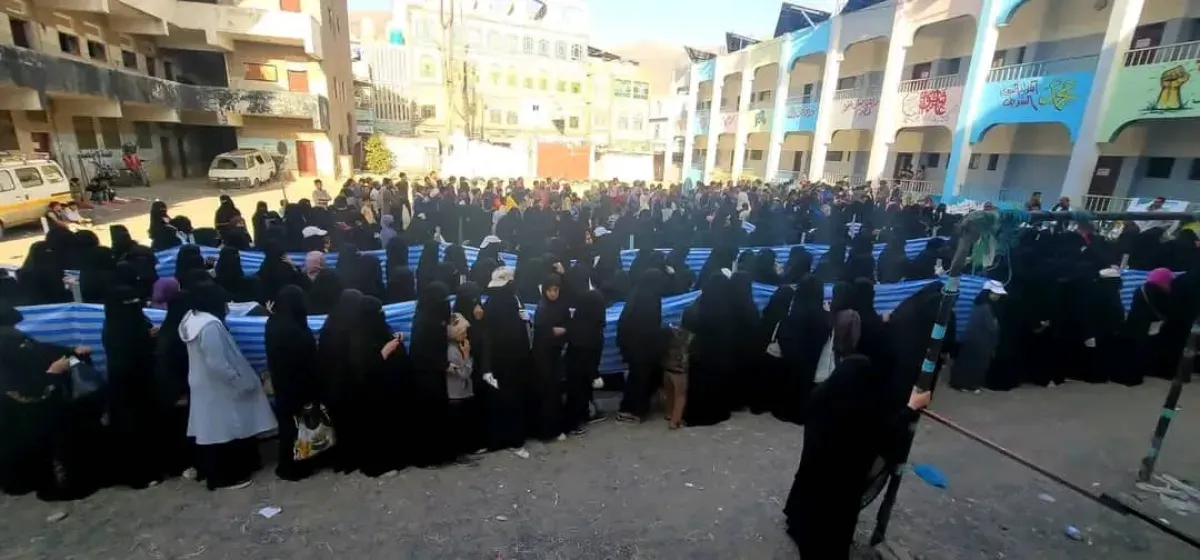
Hundreds of women in the Houthi-controlled city of Ibb were observed queuing during Ramadan to receive essential food aid, highlighting a deepening humanitarian crisis where daily hunger has become normalized. The distressing scene unfolded at Al-Shaheed Al-Sabahi School square, where women gathered awaiting simple rations to feed their children. This recurring spectacle illustrates the severe decline of Ibb Governorate, once a prosperous region, now characterized by dependency. The aid is distributed by the "Sufara' Al-Khair Kitchen," a philanthropic initiative funded by private donors, notably an individual known as Abu Yasser, which currently supports approximately 1,200 families daily. This purely humanitarian effort operates entirely outside the structure and funding mechanisms of the Houthi de facto authority, raising serious questions about local resource management. Ibb is demonstrably not an impoverished area; it is subject to extensive taxation under the guise of Zakat, endowments, public works, and sanitation fees, in addition to levies imposed on businesses. These substantial resources are centrally managed by the Houthi militias in Sana'a. Consequently, the local population is forced to rely on private charity queues for basic sustenance. The central public query revolves around the destination of official Zakat collections, endowment revenues, and fees levied for services in a city dependent on charitable kitchens for survival. More severe than the hunger itself is the ideological framework used to justify it. An expansive media apparatus continuously promotes the Houthi political narrative, attempting to sanitize policies that have impoverished the populace. These queues are reframed as "models of steadfastness," suffering is recast as "national sacrifice," and the economic catastrophe is solely attributed to external factors, while any serious discussion regarding local resource governance is suppressed. Critiques of the administration are systematically labeled as treason, and inquiries are criminalized, suggesting that demanding basic necessities like bread constitutes a deviation from religious or political loyalty. This rhetoric of justice and equity stands in stark contrast to an economic reality based on stringent, opaque collection without accountability. The image of Yemeni mothers lining up for food underscores a profound social collapse. In a city generating billions through mandatory levies, the necessity of daily appeals for assistance compromises fundamental human dignity. Charitable initiatives, while commendable, serve as a stark indicator of institutional failure, becoming a mandatory substitute for the roles that properly resourced governing bodies should fulfill. The cycle between aggressive taxation and charitable dependency exposes a system that collects resources forcefully while returning minimal, then employs propaganda to validate the resulting disparity. |