


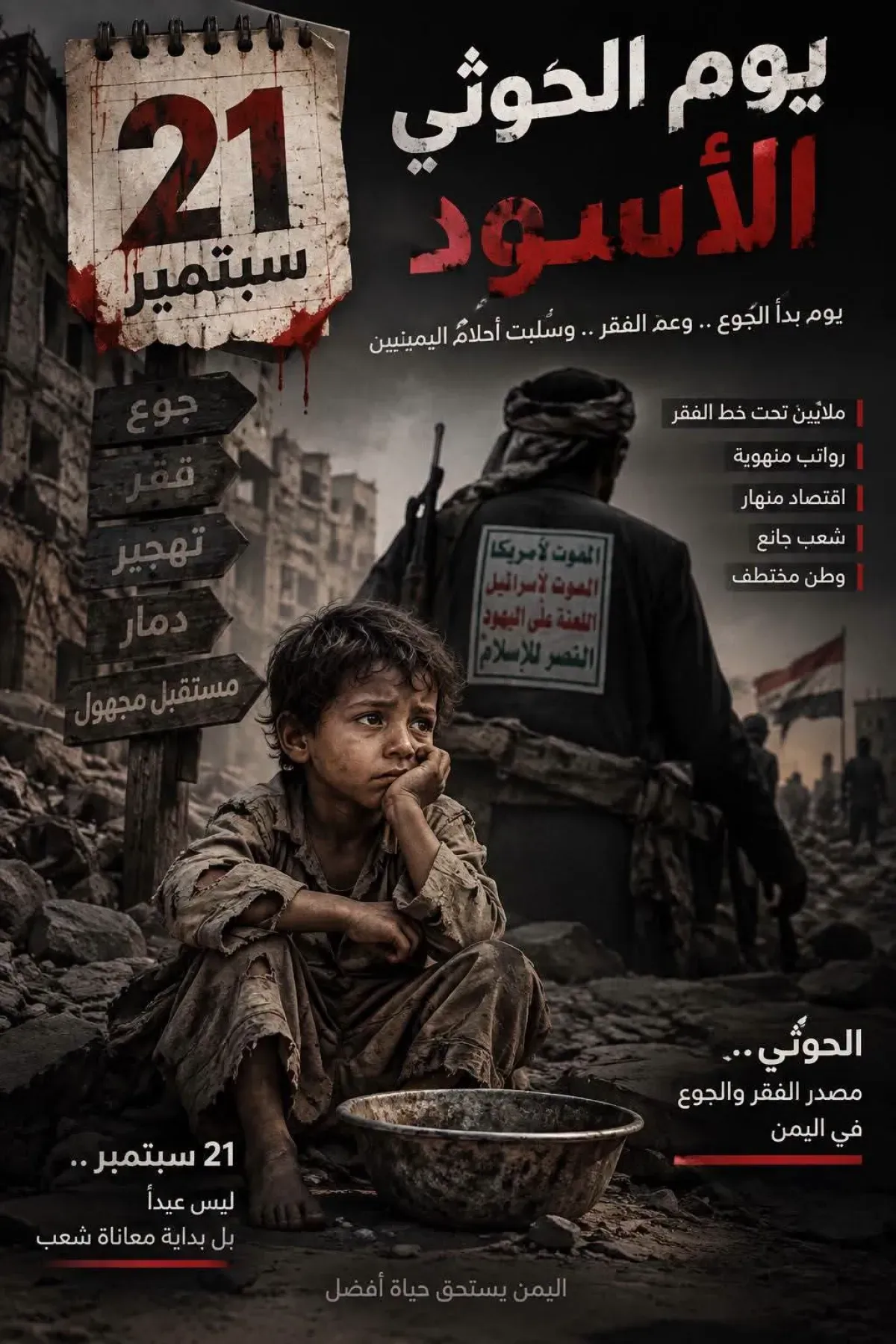
On September 21, 2014, the Houthi militia seized control of the Yemeni capital, Sana'a, by force. This armed insurrection effectively ended the political transition period, plunging Yemen into a protracted war and widespread collapse of state institutions, the economy, and essential services, the consequences of which the nation continues to endure. The fall of Sana'a was not merely a military event but the commencement of a Houthi agenda aimed at dismantling the state and its institutions. The militia imposed its rule of force on the capital, subsequently expanding its control to other governorates and regions, imposing an armed reality on millions of Yemenis and gradually pushing the country towards one of the world's most severe humanitarian crises. While the Houthi militia attempts to portray September 21st as an occasion for celebration, Yemenis recall the subsequent killings, displacement, economic ruin, and the dismantling of state institutions that followed. Sana'a transformed into the center of the militia's power and its agenda of force, repression, and armed mobilization. The coup's repercussions extended beyond the capital as the Houthi militia rapidly advanced militarily into other governorates, undermining the political arrangements Yemenis had hoped would lead to a stable civil state. By 2015, the country was embroiled in open warfare, with escalating confrontations and the collapse of state institutions under the militia's expansion. The United Nations Development Programme estimates that the war has caused hundreds of thousands of direct and indirect deaths and inflicted immense damage on development and services, reversing human development indicators by over two decades. By the end of 2021, the conflict was estimated to have resulted in approximately 377,000 war-related deaths, including those from direct combat and indirect causes such as starvation, disease, and service collapse, marking one of the most brutal humanitarian catastrophes of modern times. Economically, the Houthi coup marked a catastrophic turning point, pushing the Yemeni economy into one of its worst phases. State institutions and resources became fractured, revenues declined, production sectors faltered, the currency eroded, and the state's capacity to pay salaries and provide services diminished. The ongoing war and institutional division have torn the Yemeni market apart, creating two parallel economies, each with its own monetary institutions, pricing, and exchange rates, while citizens bear the brunt of the collapse through rising food and medicine prices, reduced purchasing power, and widening poverty. Twelve years later, the current Yemeni landscape is inseparable from the day Sana'a fell to an armed militia. The escalating war has increased the cost of the coup, and the collapse of each state institution reflects the day's impact on Yemenis' lives. Displaced individuals far from their homes, families mourning lost loved ones, employees deprived of salaries, children denied education, destroyed hospitals, schools, and infrastructure, and an economy burdened by division—these are all manifestations of a nation that has paid a heavy price since the Houthi militia chose armed force to seize power and impose its agenda. More critically, the coup's impact has extended beyond destroying state institutions and the economy to society itself, as the militia has fueled sectarian and regional rhetoric, expanded recruitment and mobilization efforts, and sent thousands of Yemenis to the front lines, while opponents have faced arrest, disappearance, and repression. For millions of Yemenis, September 21st is synonymous with the fall of the capital, the collapse of the state, the onset of war, the spread of poverty and displacement, the decline of services, the loss of thousands of lives, and the fragmentation of the nation's institutions. It is the anniversary of a day when arms were used to overthrow the state, leading to an open war whose cost Yemenis alone have borne in blood, livelihood, security, and their children's future. Twelve years on, Sana'a remains under Houthi control, and Yemenis continue their struggle to reclaim their state and institutions and end the coup, a battle that is no longer just about power but about reclaiming a nation hijacked by an armed militia, plunging the country into one of the longest and harshest crises in modern history. |