


Yemen's High School Exams Plagued by Cheating, Threatening Education
|
8 hours ago
A-
A+
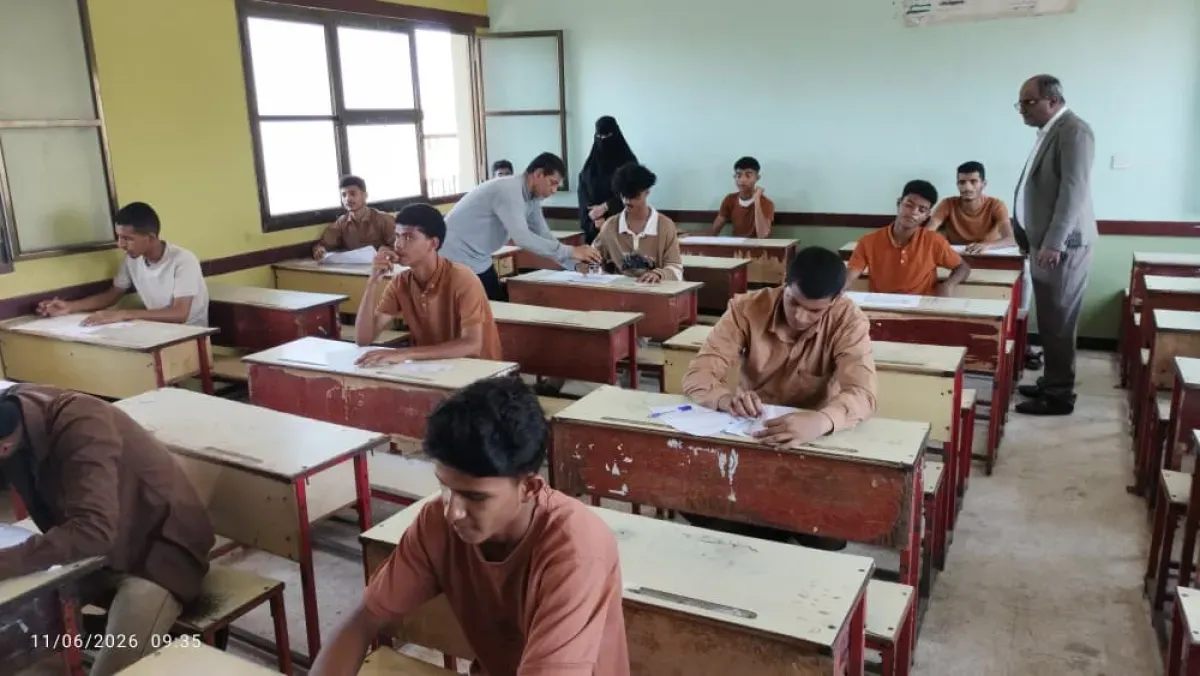
Widespread cheating in Yemen's high school examinations in the interim capital Aden exposes a crisis that extends beyond the examination process to the core of the education sector's collapse during years of war. Accusations are mounting against the internationally recognized Yemeni government for its inability to protect the remaining educational system or provide basic necessities, from teacher salaries to a fair examination environment. While authorities frequently speak of administrative and educational reforms, educational and field testimonies indicate that cheating has evolved from isolated incidents into an organized phenomenon, exploiting weak oversight and deteriorating economic conditions. This poses a threat of producing generations lacking fundamental scientific competence. According to educational sources, exam papers are leaked minutes after distribution within examination halls. Mobile phones are used to photograph questions and send them to teachers outside the centers, who then solve them and redistribute answers via WhatsApp groups specific to each center before they are circulated among students. Sources told Al-Khabar News Agency that mobile phones, which are supposed to be confiscated before exams, are returned to three or four students in each hall about an hour after the test begins, a process reportedly coordinated with some invigilators, rendering anti-cheating measures merely symbolic and ineffective. Observers have noted that students in several centers are collecting daily sums of money and handing them to some supervisors in exchange for overlooking the introduction of answers or facilitating their circulation within halls. This reveals the deep penetration of corruption in one of the most critical educational stages that determines the future of thousands of students. The crisis is not limited to oversight; educational sources indicate a significant decline in the quality of exam questions compared to previous years. Questions have become simpler, confined to a few pages with answers written directly on them, a stark contrast to the more complex models and separate answer sheets previously used, which educators consider further evidence of declining educational quality. Teachers attribute a large part of the responsibility for these phenomena to their deteriorating living conditions, emphasizing that the average teacher's salary, not exceeding approximately 60,000 Yemeni riyals, has lost most of its purchasing power, equivalent to about 150 Saudi riyals at current exchange rates, compared to approximately 1,500 Saudi riyals before the war began in 2015. In recent years, teachers have staged numerous protests and strikes demanding salary increases and regular payments commensurate with the sharp rise in the cost of living. However, they state that the government's response has been limited to promises without practical solutions, while food and essential goods prices have risen to levels 15 times higher than before the war, pushing many families to the brink of poverty. Educators believe this harsh economic reality has contributed to some education sector workers accepting practices they previously rejected, despite understanding their serious implications for the country's future. They point to the government leadership and relevant ministries as directly responsible for the environment that has allowed corruption to spread within schools due to the continued erosion of employee wages and neglect of sector reform. Concurrently, students face exceptional circumstances hindering their exam preparation. The electricity crisis persists in Aden, with recent weeks seeing outages of up to 20 hours daily against only four hours of operation, coinciding with heatwaves where temperatures ranged between 37 and 44 degrees Celsius in several coastal areas. Students told Al-Khabar News Agency that the prolonged power outages have made night-time revision almost impossible, especially with high temperatures and the absence of alternatives, which has affected their ability to prepare for exams. Many families are unable to afford alternative power sources due to the deteriorating economic conditions. Observers believe that the continuation of this situation not only threatens the integrity of the exams but also undermines confidence in the entire educational system, as graduating batches of students with low scientific abilities will have long-term repercussions on universities, the labor market, and state institutions. Educational specialists who spoke to Al-Khabar News Agency suggest that the Ministry of Education should consider installing surveillance cameras inside examination halls and strengthening inspection and oversight mechanisms. This should run parallel to addressing the root causes of the crisis, primarily improving teachers' living conditions and ensuring the regular payment of their salaries and the restoration of their real value, which is considered an essential condition for saving education from the path of collapse it has been on for years. In response, several journalists and activists have condemned what they described as "the farce that the education sector is subjected to under the guise of high school certificate exams," stating that the widespread cheating has stripped the exams of their true value and harmed the principle of equal opportunity among students. Journalist Fathi bin Lazraq stated, "What is happening today are organized cheating operations, and the student who cheats is now luckier in obtaining higher grades than the diligent student," referring to what he considers a serious imbalance in educational assessment criteria. Bin Lazraq, along with other journalists and observers of the Yemeni educational scene, called for a review of the assessment mechanism for secondary school students. They proposed replacing the final exam system with a cumulative average calculation over the three years of secondary study, from which the final grade reflecting the student's true academic level would be derived, thereby reducing cheating and promoting fairness in assessing academic achievement. In a country suffering one of the world's worst humanitarian and economic crises, the battle for education reform seems far beyond merely combating cheating. It is linked to the state's ability to restore its institutions and protect entire generations from falling victim to poverty, corruption, and service collapse, a responsibility many Yemenis believe the government has failed to undertake over the past decade. |