


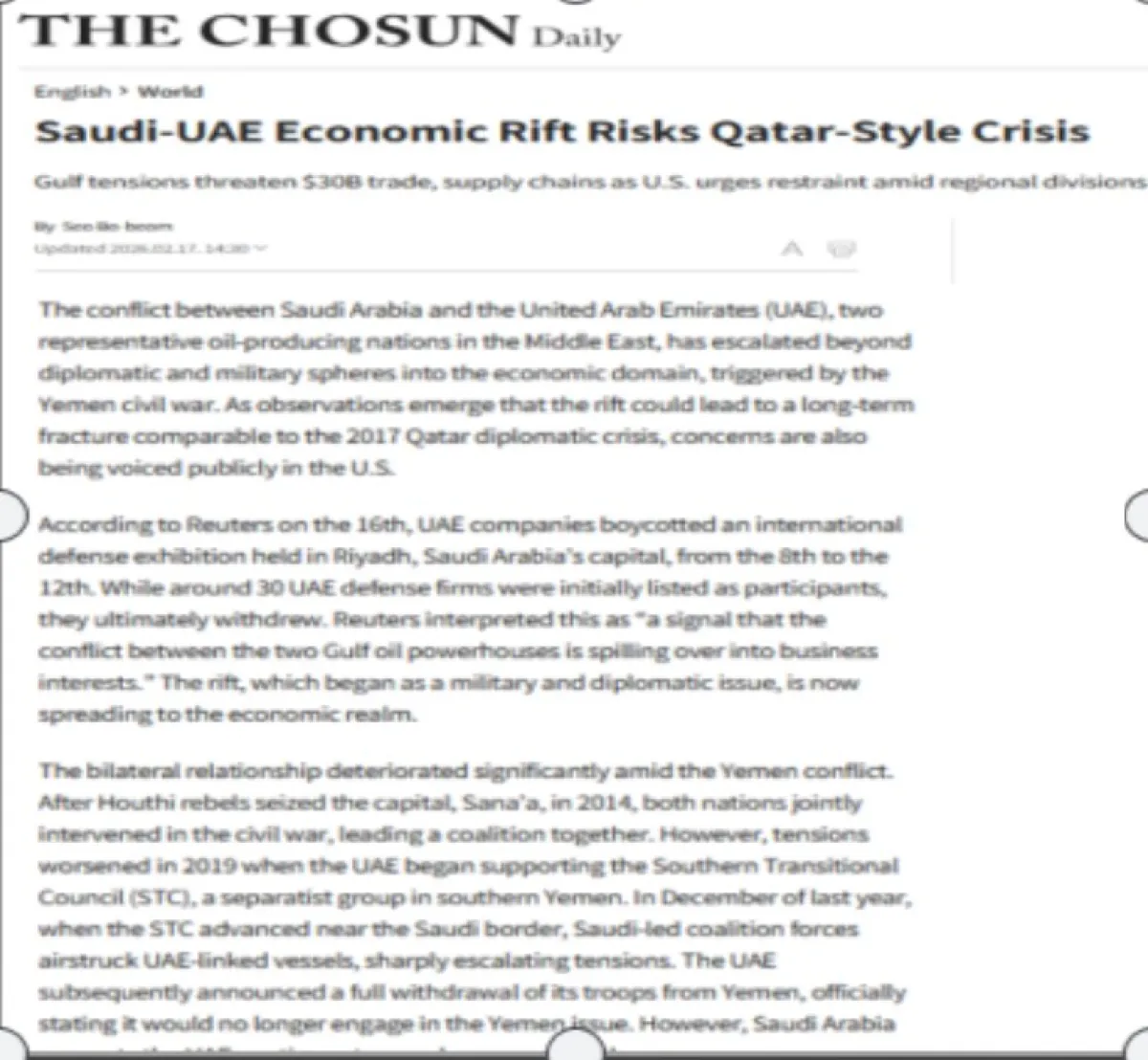
The conflict between Saudi Arabia and the United Arab Emirates (UAE), two representative oil-producing nations in the Middle East, has escalated beyond diplomatic and military spheres into the economic domain, triggered by Yemen’s crisis, according to The Chosun Daily newspaper’s article. The author of the article noticed “As observations emerge that the rift could lead to a long-term fracture comparable to the 2017 Qatar diplomatic crisis, concerns are also being voiced publicly in the U.S”. According to Reuters on the 16th, UAE companies boycotted an international defense exhibition held in Riyadh, Saudi Arabia’s capital, from the 8th to the 12th. While around 30 UAE defense firms were initially listed as participants, they ultimately withdrew. Reuters interpreted this as “a signal that the conflict between the two Gulf oil powerhouses is spilling over into business interests.” The rift, which began as a military and diplomatic issue, is now spreading to the economic realm. The bilateral relationship deteriorated significantly amid the Yemen conflict. Tensions worsened in 2019 when the UAE began supporting the In December of last year, when the Southern Transitional Council (STC), a separatist group in southern Yemen, supported be UAE advanced near the Saudi border, and Saudi-led coalition forces airs truck UAE-linked vessels, sharply escalating tensions. The UAE subsequently announced a full withdrawal of its troops from Yemen, officially stating it would no longer engage in the Yemen issue. However, Saudi Arabia suspects the UAE continues to supply weapons to the group. The differing support for opposing factions stems from geopolitical interests. Saudi Arabia prioritizes stabilizing its 1,800 km border with Yemen and insists on continued intervention until a pro-Saudi regime is established. In contrast, the UAE is analyzed to be pursuing a strategy to secure logistics and maritime interests through southern ports controlled by the STC. The clash between the two nations is also manifesting in Sudan. The UAE is reported to support the Rapid Support Forces (RSF), while Saudi Arabia backs the regular army. The New York Times (NYT) noted, “The Gulf region has not been this divided since the 2017 Qatar diplomatic crisis.” Concerns over economic repercussions are growing. Annual trade between the two countries amounts to approximately 30 billion dollars. Unlike during the Qatar crisis, their economies are now far more intertwined, raising forecasts that prolonged conflict could impact aviation, logistics, and supply chains. Reuters reported that companies are beginning to assess potential risks, including flight disruptions and supply chain issues. The rift between the two nations, once dubbed the “twin engines” of Gulf security cooperation, is also burdening U.S. Middle East strategy. U.S. Senator Lindsey Graham, a close ally of President Donald Trump, urged restraint at the Munich Security Conference in Germany on the 13th, stating, “Such conflicts only embolden Iran.” The NYT analyzed that the U.S. finds it difficult to clearly support either side amid conflicting interests in Yemen and Sudan. |